Showing posts with label 2015 b.e / b.tech ieee j2ee projects. Show all posts

Thursday, 22 October 2015

DETECTING MALICIOUS FACEBOOK APPLICATIONS


ABSTRACT:
With 20 million installs a day, third-party apps are a major reason for the popularity and addictiveness of Facebook. Unfortunately, hackers have realized the potential of using apps for spreading malware and spam. The problem is already significant, as we find that at least 13% of apps in our dataset are malicious. So far, the research community has focused on detecting malicious posts and campaigns. In this paper, we ask the question: Given a Face book application, can we determine if it is malicious? Our key contribution is in developing FRAppE—Face book’s Rigorous Application Evaluator—arguably the first tool focused on detecting malicious apps on Face book. To develop FRAppE, we use information gathered by observing the posting behavior of 111K Face book apps seen across 2.2 million users on Face book. First, we identify a set of features that help us distinguish malicious apps from benign ones. For example, we find that malicious apps often share names with other apps, and they typically request fewer permissions than benign apps. Second, leveraging these distinguishing features, we show that FRAppE can detect malicious apps with 99.5% accuracy, with no false positives and a high true positive rate (95.9%). Finally, we explore the ecosystem of malicious Face book apps and identify mechanisms that these apps use to propagate. Interestingly, we find that many apps collude and support each other; in our dataset, we find 1584 apps enabling the viral propagation of 3723 other apps through their posts. Long term, we see FRAppE as a step toward creating an independent watchdog for app assessment and ranking, so as to warn Face book users before installing apps
AIM
FRAppE (Face book’s Rigorous Application Evaluator) tool focused on detecting malicious apps on Face book.
SCOPE
The research community has focused on detecting malicious posts and campaigns
EXISTING SYSTEM
The driving motivation for detecting malicious apps stems from the suspicion that a significant fraction of malicious posts on Face book are posted by apps. We find that 53% of malicious posts flagged by MyPageKeeper were posted by malicious apps. We see that 60% of malicious apps were able to accumulate over 100K clicks each, with 20% receiving more than 1M clicks each. The application with the highest number of bit.ly clicks in this experiment—the “What is the sexiest thing about you?” app—received 1 742 359 clicks. Although it would be interesting to find the bit.ly click-through rate per user and per post, we do not have data for the number of users who saw these links. We can query bit.ly’s API only for the number of clicks received by a link
DISADVANTAGES:

  1. 60% of malicious apps get at least a hundred thousand clicks on the URLs they post
  2. 40% of malicious apps have a median of at least 1000 monthly active users

PROPOSED SYSTEM
In this paper, we develop FRAppE, a suite of efficient classification techniques for identifying whether an app is malicious or not. To build FRAppE, we use data from My Page- Keeper, a security app in Face book that monitors the Face book profiles of 2.2 million users. We analyze 111K apps that made 91 million posts over 9 months. This is arguably the first comprehensive study focusing on malicious Face book apps that focuses on quantifying, profiling, and understanding malicious apps and synthesizes this information into an effective detection approach.
ADVANTAGES

  1.  13% of observed apps are malicious
  2.  Malicious hackers impersonate applications.
  3.  FRAppE can detect malicious apps with 99% accuracy.

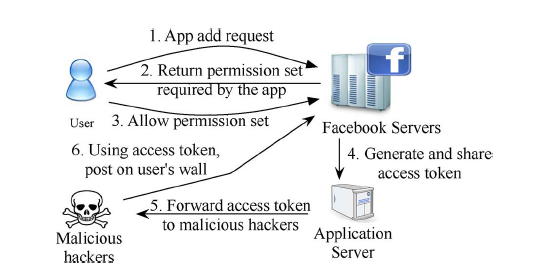
SYSTEM ARCHITECTURE


SYSTEM CONFIGURATION

HARDWARE REQUIREMENTS:-

·                Processor          -   Pentium –III

·                Speed                -    1.1 Ghz
·                RAM                 -    256 MB(min)
·                Hard Disk         -   20 GB
·                Floppy Drive    -    1.44 MB
·                Key Board         -    Standard Windows Keyboard
·                Mouse               -    Two or Three Button Mouse
·                Monitor             -    SVGA

SOFTWARE REQUIREMENTS:-

·                Operating System              : Windows  7                                       
·                Front End                  : JSP AND SERVLET
·                Database                  : MYSQL
·                Tool                           :NETBEANS
 REFERENCE:
Rahman, S.Huang, T.-K. ; Madhyastha, H.V. Faloutsos, M. “Detecting Malicious Facebook Applications” IEEE/ACM Transactions on Networking Volume PP,  Issue 99 JANUARY 2015.

A Distortion-Resistant Routing Framework for Video Traffic In Wireless Multihop Networks


ABSTRACT:
Traditional routing metrics designed for wireless networks are application-agnostic. In this paper, we consider a wireless network where the application flows consist of video traffic. From a user perspective, reducing the level of video distortion is critical. We ask the question “Should the routing policies change if the end-to-end video distortion is to be minimized?” Popular link-quality-based routing metrics (such as ETX) do not account for dependence (in terms of congestion) across the links of a path; as a result, they can cause video flows to converge onto a few paths and, thus, cause high video distortion. To account for the evolution of the video frame loss process, we construct an analytical framework to, first, understand and, second, assess the impact of the wireless network on video distortion. The framework allows us to formulate a routing policy for minimizing distortion, based on which we design a protocol for routing video traffic. We find via simulations and test bed experiments that our protocol is efficient in reducing video distortion and minimizing the user experience degradation.
AIM
The aims of this paper are an analytical framework to, first, understand and, second, assess the impact of the wireless network on video distortion.
SCOPE
 The Scope of this paper is allows us to formulate a routing policy for minimizing distortion, based on which we design a protocol for routing video traffic.
EXISTING SYSTEM
In these protocols, one of the critical functionalities that is often neglected, but affects the end-to-end quality of a video flow, is routing. Typical routing protocols, designed for wireless multi hop settings, are application-agnostic and do not account for correlation of losses on the links that compose a route from a source to a destination node. Furthermore, since flows are considered independently, they can converge onto certain links that then become heavily loaded (thereby increasing video distortion), while others are significantly underutilized. The decisions made by such routing protocols are based on only network (and not application) parameters. As one of our main contributions, we construct an analytical model to characterize the dynamic behavior of the process that describes the evolution of frame losses in the GOP (instead of just focusing on a network quality metric such as the packet-loss probability) as video is delivered on an end-to-end path. Specifically, with our model, we capture how the choice of path for an end-to-end flow affects the performance of a flow in terms of video distortion. The packet-loss probability on a link is mapped to the probability of a frame loss in the GOP. The frame-loss probability is then directly associated with the video distortion metric.

DISADVANTAGES:
  1. From a user perspective, reducing the level of video distortion is critical.
  2. Popular link-quality-based routing metrics (such as ETX) do not account for dependence (in terms of congestion) across the links of a path; as a result, they can cause video flows to converge onto a few paths and, thus, cause high video distortion.

PROPOSED SYSTEM
In this paper, Developing  an analytical framework to capture the impact of routing on video distortion: As our primary contribution, we develop an analytical framework that captures the impact of routing on the end-to-end video quality in terms of distortion Design of a practical routing protocol for distortion-resilient video delivery: Based on our analysis, we design a practical routing protocol for a network that primarily carries wireless video Evaluations via extensive experiments: We demonstrate via extensive simulations and real test bed experiments on a multi hop 802.11a test bed that our protocol is extremely effective in reducing the end-to-end video distortion and keeping the user experience degradation to a minimum

ADVANTAGES
  1.  Our simulation study shows that the distortion (in terms of PSNR) is decreased by 20% compared to ETX-based routing
  2.  The user experience degradation due to increased traffic load in the network is kept to a minimum.


SYSTEM CONFIGURATION

HARDWARE REQUIREMENTS:-

·                Processor          -   Pentium –III

·                Speed                -    1.1 Ghz
·                RAM                 -    256 MB(min)
·                Hard Disk         -   20 GB
·                Floppy Drive    -    1.44 MB
·                Key Board         -    Standard Windows Keyboard
·                Mouse               -    Two or Three Button Mouse
·                Monitor             -    SVGA

SOFTWARE REQUIREMENTS:-

·                Operating System      : Windows  7                                       
·                Front End                  : JSP AND SERVLET
·                Database                  : MYSQL
·                Tool                           :NETBEANS


REFERENCE:
Papageorgiou, G. Singh, S. , Krishnamurthy, S.V. , Govindan, R.. “A Distortion-Resistant Routing Framework for Video Traffic In Wireless Multi hop Networks”, IEEE/ACM Transactions on Networking, Volume 23, Issue 2 FEBRUARY 2014.