Showing posts with label 2015 b.e / b.tech ieee dotnet projects. Show all posts

Thursday, 22 October 2015

Tees- An Efficient Search Scheme Over Encrypted Data On Mobile Cloud


ABSTRACT:
Cloud storage provides a convenient, massive, and scalable storage at low cost, but data privacy is a major concern that prevents users from storing files on the cloud trustingly. One way of enhancing privacy from data owner point of view is to encrypt the files before outsourcing them onto the cloud and decrypt the files after downloading them. However, data encryption is a heavy overhead for the mobile devices, and data retrieval process incurs a complicated communication between the data user and cloud. Normally with limited bandwidth capacity and limited battery life, these issues introduce heavy overhead to computing and communication as well as a higher power consumption for mobile device users, which makes the encrypted search over mobile cloud very challenging. In this paper, we propose TEES (Traffic and Energy saving Encrypted Search), a bandwidth and energy efficient encrypted search architecture over mobile cloud. The proposed architecture offloads the computation from mobile devices to the cloud, and we further optimize the communication between the mobile clients and the cloud. It is demonstrated that the data privacy does not degrade when the performance enhancement methods are applied. Our experiments show that TEES reduces the computation time by 23% to 46% and save the energy consumption by 35% to 55% per file retrieval, meanwhile the network traffics during the file retrievals are also significantly reduced.
AIM
The aim of this paper is TEES (Traffic and Energy saving Encrypted Search), a bandwidth and energy efficient encrypted search architecture over mobile cloud
SCOPE
The Scope of this paper is to the data privacy does not degrade when the performance enhancement methods are applied.
EXISTING SYSTEM
In this existing file encryption schemes and it cannot deal with compressing data. After that many methods of keyword search showed up. In Information Retrieval, F-IDF (term frequency-inverse document frequency) is a statistic which reflects how important a word is to a document in a collection or corpus. It is often used as a weighting factor in keyword-based retrieval and text mining. The TF-IDF algorithm proposed by Salton and McGill’s book is one of the most popular schemes, among other schemes as encrypted search includes Boolean keyword search and ranked keyword search. In Boolean keyword search the server sends back files only based on the existence or absence of the keywords, without looking at their relevance. It provided a scheme of keyword search, but it does not send back the most relevant files. In ranked encrypted search, the server sends back the top-k ranked files. Most of the previous schemes used OPE to encrypt the index of the file set, although the fully homomorphic encryption method could also be used.
DISADVANTAGES:

  1. Data  encryption is a heavy overhead for the mobile devices, and data retrieval process incurs a complicated communication between the data user and cloud
  2. Limited  bandwidth capacity and limited battery life, these issues introduce heavy overhead to computing and communication as well as a higher power consumption for mobile device users, which makes the encrypted search over mobile cloud very challenging.

 PROPOSED SYSTEM
Currently, many researches focus on improving the encrypted search accuracy with multi-keywords ranking. Wang et al. proposed a one round trip search scheme which could search the encrypted data. It worth noticing that multi-keyword ranked search may incur more serious Keywords-files Association Leak problem (mentioned in Section If attackers observed the keywords and the return files to learn some relationships between keywords and files, especially through wireless communication channels for mobile cloud. Cao et al. proposed privacy preserving method for multi-keyword encrypted search with a way to control the ‘double key leak”. In a fuzzy multi-keyword fuzzy search scheme was presented, but it suffers from inefficient search time with
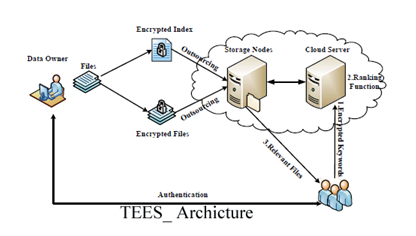
two round-trip communications. Note that multi-keyword is potentially the future main stream encrypted search scheme with higher searching accuracy, but current on-going research cannot provide an authoritative method. Therefore, we will employ the single keyword with OPE TF-IDF encryption method as a basis to establish a more power and traffic efficient encrypted data search architecture.
ADVANTAGES

  1. TEES reduces the computation time by 23% to 46% and save the energy consumption by 35% to 55% per file retrieval.
  2.  The network traffics during the file retrievals are also significantly reduced.

SYSTEM ARCHITECTURE


SYSTEM CONFIGURATION

HARDWARE REQUIREMENTS:-

·                Processor          -   Pentium –III

·                Speed                -    1.1 Ghz
·                RAM                 -    256 MB(min)
·                Hard Disk         -   20 GB
·                Floppy Drive    -    1.44 MB
·                Key Board                 -    Standard Windows Keyboard
·                Mouse               -    Two or Three Button Mouse
·                Monitor             -    SVGA

SOFTWARE REQUIREMENTS:-

·                Operating System      : Windows  7                                     
·                Front End                  : ASP.NET and C#
·                Database                   : MSSQL
·                Tool                           :Visual Studio


REFERENCE:
Ma, R. ; Guan, H. Li, J. “TEES: An Efficient Search Scheme over Encrypted Data on Mobile Cloud” IEEE/ACM Transactions on Cloud Computing Volume PP,  Issue 99 FEBRUARY  2015.

Selcsp: A Framework To Facilitate Selection Of Cloud Service Providers


 Abstract
With rapid technological advancements, cloud marketplace witnessed frequent emergence of new service providers with similar offerings. However, service level agreements (SLAs), which document guaranteed quality of service levels, have not been found to be consistent among providers, even though they offer services with similar functionality. In service outsourcing environments, like cloud, the quality of service levels are of prime importance to customers, as they use third-party cloud services to store and process their clients’ data. If loss of data occurs due to an outage, the customer’s business gets affected. Therefore, the major challenge for a customer is to select an appropriate service provider to ensure guaranteed service quality. To support customers in reliably identifying ideal service provider, this work proposes a framework, SelCSP, which combines trustworthiness and competence to estimate risk of interaction. Trustworthiness is computed from personal experiences gained through direct interactions or from feedbacks related to reputations of vendors. Competence is assessed based on transparency in provider’s SLA guarantees. A case study has been presented to demonstrate the application of our approach. Experimental results validate the practicability of the proposed estimating mechanisms
Aim
The aim of this paper proposes a framework, SelCSP, which combines trustworthiness and competence to estimate risk of interaction.
Scope:
The scope of this paper tends to validate the practicability of the proposed estimating the risk of interaction.
Existing System
In most cases, it has been observed that the failover time is quite long and customers’ businesses were hugely affected owing to lack of recovery strategy on vendor side. Moreover, in some instances, customers were not even intimated about the outage by providers. Cloud providers may use the high-quality first replication (HQFR) strategy proposed in to model their recovery mechanism. In this work, authors propose algorithms to minimize replication cost and the number of QoS-violated data replicas. Hence, it is desirable from customer’s point of- view to avoid such loss, rather than getting guarantees of service credits following a cloud outage. Avoidance of data loss requires reliable identification of competent service provider. As customer does not have control over its data deployed in cloud, there is a need to estimate risk prior to outsourcing any business onto a cloud. This motivated us to propose a risk estimation scheme which makes a quantitative assessment of risk involved while interacting with a given service provider.
 Disadvantages

  1.  Lack of assurances and violations for SLA guarantees
  2.  Multi-tenancy, lack of customer’s control over their data and application
  3. Non-transparency with respect to security profiles of remote datacenter locations

Proposed System
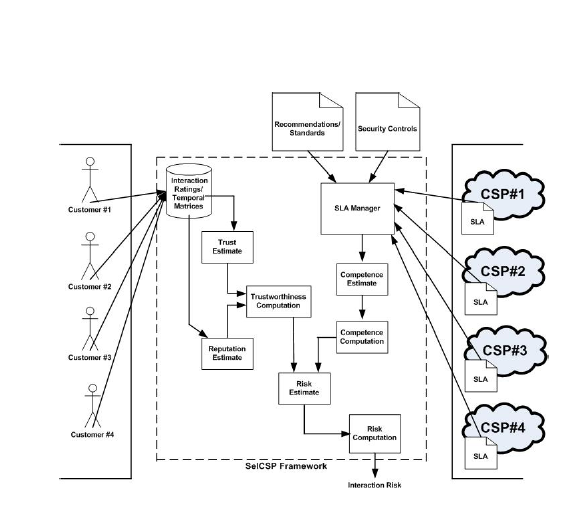
In this paper estimation of risk of interaction in cloud environment has not been addressed. Hence, in this respect, the current work is significant as it proposes a framework, SelCSP , which attempts to compute risk involved in interacting with a given cloud service provider. The framework estimates perceived level of interaction risk by combining trustworthiness and competence of cloud provider. Trustworthiness is computed from ratings obtained through either direct interaction or feedback.
 Advantages

  1. The framework estimates trustworthiness in terms of context-specific, dynamic trust and reputation feedbacks.
  2. Both these entities are combined to model interaction risk, which gives an estimate of risk level involved in an interaction


System Architecture
 
SYSTEM CONFIGURATION

HARDWARE REQUIREMENTS:-

·                Processor          -   Pentium –III

·                Speed                -    1.1 Ghz
·                RAM                 -    256 MB(min)
·                Hard Disk         -   20 GB
·                Floppy Drive    -    1.44 MB
·                Key Board                 -    Standard Windows Keyboard
·                Mouse               -    Two or Three Button Mouse
·                Monitor             -    SVGA

SOFTWARE REQUIREMENTS:-

·                Operating System      : Windows  7                                     
·                Front End                  : ASP.NET and C#
·                Database                   : MSSQL
·                Tool                           :Visual Studio
References
Ghosh, N.,Ghosh, S.K.,  Das, S.K. “SelCSP: A Framework to Facilitate Selection of Cloud Service Providers” IEEE Transactions on Cloud Computing, Volume 3 ,  Issue 1 JULY 2014.